
Most advice we hear as musicians about Spotify follows the same narrative, that is “Release music, a lot. Build an audience and grow over time”. It is logical and something that used to work in terms of strategy. It’s also widely repeated. But when we looked at the data, that model doesn’t seem to follow reality. Instead of a steady and gradual growth, the reality is that it’s a system where visibility is uneven, momentum is everything and most artists struggle to break through in the first place.
What We Analyzed
To get a better sense of how artists actually perform on Spotify, we collected data on around 4,800 artists across multiple genres (as of April 25, 2026) via some nerdy Python scripts and Spotify’s API end points. For each artist we check out:
- Follower counts
- Spotify popularity score
- Performance across their top tracks
The dataset actually reflects artists surfaced through Spotify’s search and discovery system, not every artist on the platform! It’s a distinction that helps us talk about the challenge.
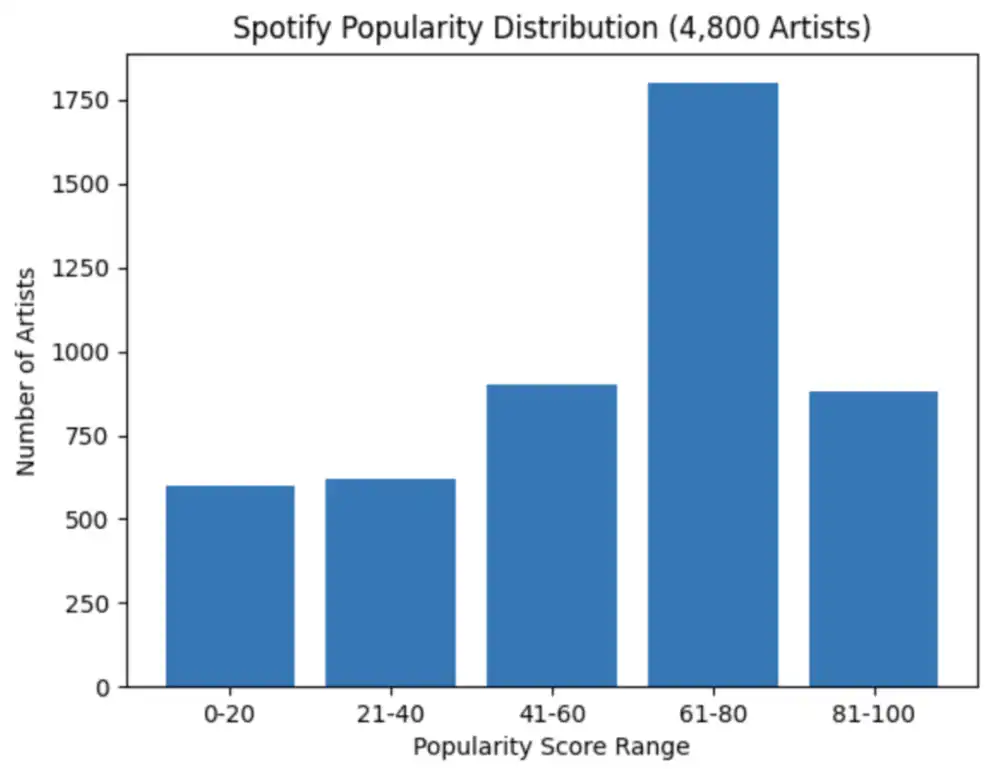
Spotify’s Popularity Score Is a High-School “Popular Kids” Lunch Table, And You’re Not Invited!
This metric behaves more like a social system than a neutral measurement. It’s a 0-100 score that represents how “popular” a song is and it’s NOT a lifetime achievement score. It’s a dynamic measure of recent song performance. Spotify has stated that the popularity score is based on factors like total plays, how recent those plays are, and how often people are listening. A song that was huge a year ago but isn’t being played today will see a significant score drop while a new track that is gaining traction will have a higher score. Think of it as “current momentum”. There’s no official “cutoff” where Spotify will suddenly start promoting your music via algorithms.
Spotify Focuses on Artists Who Already Have Traction
This is more than likely not a surprise to you that the data provided skews heavily towards artists who are already doing well on the platform. Major surprise right? To be honest we were hoping to see a wider spread based on performance. Here’s a breakdown:
Median popularity score: 63
Average popularity score: 54.6
In other words, the average artist in this data is not struggling, they’re already gaining traction. What conclusion can we derive from this? Spotify’s discovery layer is not neutral, it favors artists who are already performing well. In other words, what listeners experience on the Spotify platform is not a balanced representation of all artists, it’s a filtered layer shaped by engagement.
For context, top artists on Spotify typically sit in the 80-95+ popularity range with consistent high engagement across multiple tracks. Artists like Drake, Taylor Swift or Bad Bunny maintain these levels because their music generates massive ongoing listener activity.
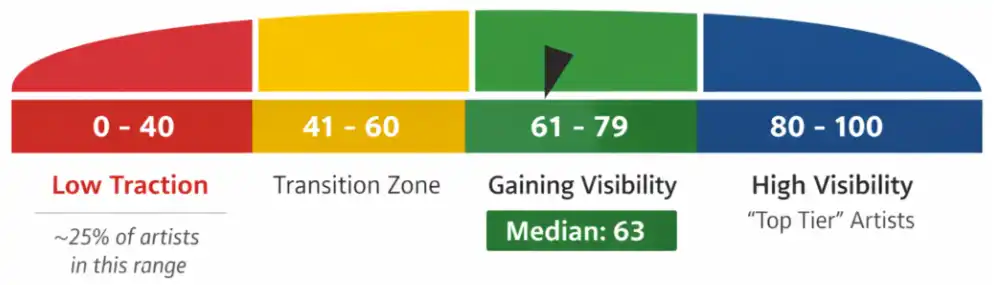
There’s hardly a Middle Class on Spotify
The data supports what most indie artists are feeling even if it’s somewhat hard to explain at a technical level. There’s no real smooth path upwards, there’s a gap. In this particular dataset of 4,800 artists, 1 in 4 never gain any real traction and are simply just not breaking through. And importantly, these aren’t artists with no presence or bad music. Many have thousands of followers (some upwards of 10,000) along with multiple tracks showing measurable engagement. They are releasing music and people are in fact listening but it’s not enough to trigger any meaningful visibility on Spotify.
What this reveals is an invisible threshold. If you are below it, your music exists but never travels. Above the threshold and the platform starts working FOR you. Recommendations increase, discovery expands and growth actually compounds. There’s no real “in between” and you do not gradually climb into visibility. You cross that invisible line or you don’t. As the saying goes, “Do or do not. There is no try.” That tension creates what we may call algorithm-anxiety: the feeling that your work is active but not being amplified.
Why Does This Happen?
Spotify’s recommendation system is driven by what listeners (or their users) do, not just content availability. It will prioritize signals like repeat listens, lower skip rates and consistent engagement over time. When artists' music generates these types of signals, the system will respond by increasing exposure (in the hope that their listeners will stay engaged on the platform and continue to pay the monthly fee). Essentially this creates a feedback loop where early engagement leads to more visibility which then brings more listeners, driving even more engagement and “rinse and repeat”.
Case Study
Artists like Angine de Poitrine are a good example of this dynamic. Despite having unconventional microtonal music, they’ve reached a popularity score of 67 which is above the dataset median of 63. They are not fighting for visibility, they are being actively surfaced by the platform being rewarded for their engagement. As of the time of this article they have over 2.2 million monthly listeners, almost half million followers and their top song Fabienk has over 5.7 million listens. Ironically, using them as a case-study in this article is further proof of a momentum-loop.
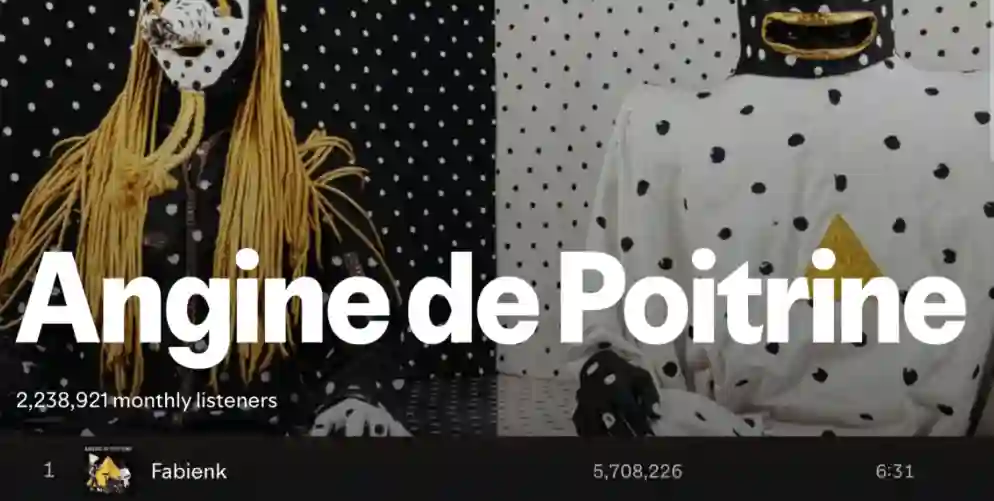
What’s interesting is how they likely got to this level of Spotify statistics. Angine de Poitrine STANDS OUT! They have a distinctive visual language including poker-dot patterns and papier-mâché-style masks. Their use of a custom looking double-neck microtonal instrument, loop driven arrangements, everything about the project feels cohesive and immediately recognizable. It’s not just the music that is different, the entire presentation is different, creative and brilliant.
Combined with a polished, professional sound, this creates something rare: music that not only stands out but holds attention. Which matters because attention is what drives engagement signals a platform like Spotify responds to. Angine de Poitrine didn’t grow because they fit the system, they grew because they triggered it.
Spotify Doesn’t Reward Presence, It Rewards Momentum
The idea that artists can steadily grow on Spotify is appealing but it doesn’t seem to work this way. What the data indicates is a platform driven by momentum. Visibility isn’t given evenly and it will not build overtime on its own. You need engagement and once that engagement crosses a certain level, growth starts to compound.
Talent isn’t the struggle for most, the struggle is to generate signals for platforms like Spotify.
What All This Means for Artists?
Releasing music on its own is not enough. The data proves what we already know and should reframe how artists should think about their audience and that engagement threshold. The strategy is to build momentum EARLY! We can borrow some product go-to-market strategies and relay it to releasing music.
That means treat your releases like tests. Before you drop a track via your favorite distributor, get it in front of real listeners, be it from TikTok snippets, Discord communities, SongTakes feedback tools, email lists or even small paid ads and observe how real people respond. Are they replaying the music, saving it, sharing it? If not, the issue isn’t exposure yet. It’s that the track isn’t generating a strong enough signal.
Once you actually release (after testing and seeing strong positive signals from your testing), you need to concentrate your attention in a very short window. Drive as much activity as possible in the first few days! Push listeners (your existing fans, friends and family) to save the track, replay it, add it to playlists. This is what tells the Spotify system “hey this song will help your users love being on Spotify, let’s get it in front of more users”.
With that being said, aim for consistency across releases rather than chasing a single viral moment. Artists who break through that threshold tend to build repeat engagement across multiple songs, not just one spike. In practical terms, that means releasing regularly but applying the growth strategy to every single release. Yes… it is a TON of work! It’s not just to put music out there, it’s to generate a buzz or the kind of engagement that forces the platform to pay attention!
💡 More Info: Get more in depth with a 3 part series on music marketing.
Promoting Your Music Used to Be Hard
From playlist pitching to EPKs and email updates, SongTakes makes music marketing something you can actually do well.