
A lot of musicians are directed to focus on content and consistency across a ton of platforms. “Post more on TikTok, stay active on Instagram, get your music to Spotify” - That isn’t wrong advice, it's just not totally complete.
The problem most up and coming artists face right now isn’t getting attention, it’s keeping it. That’s where most music careers quietly fall apart. And that’s why, yes, musicians still need a band website today, it’s not an outdated “nice to have”.
What Is a Band Website?
A band website is a centralized online space where an artist controls how their music, brand, and content are presented, while giving fans a way to engage beyond social media and streaming platforms.
Unlike third-party platforms, a website allows you to:
- Decide what visitors see first
- Showcase your best work without distractions
- Create a consistent experience around your music
Do Musicians Still Need a Band Website?
YES! If the goal is to build something sustainable and make a career out of music, a website does become important! The role of a band website has changed however, it’s no longer your primary discovery channel. It’s what sits behind everything else. Social media and streaming platforms can create moments and your band website is what gives those moments somewhere to go and capture a means to continue to communicate with the audience.
Why Social Media and Streaming Aren’t Enough on Their Own
We are all at the mercy of how platforms behave, a change of an algorithm we have zero control over can either make or break us. Social platforms are effective at distributing content but they’re not designed to build long-term relationships between artists and listeners. Because of this, reach is inconsistent and you can have thousands of followers and still reach only a fraction of them with each post. Content moves extremely fast and the lifespan of anything you publish can be short. Even when something performs well, it can fade quickly.
If there’s one thing that’s become clearer over time, it’s this: platforms are optimized to keep users inside their ecosystem. External links do not perform as well as on-platform content. That’s because social and streaming platforms generate revenue by ensuring users stay on their platforms, and your content becomes part of the platform’s product and you have no control on what, how, when or to whom your content is displayed.
Streaming platforms have different limitations. They’re optimized for listening, not connection. Someone might play your song and actually enjoy it but never think about you again. You don’t know who they are, you cannot reach them and you have no control over whether they will ever hear your music again.
Cross-Platform Movement Matters
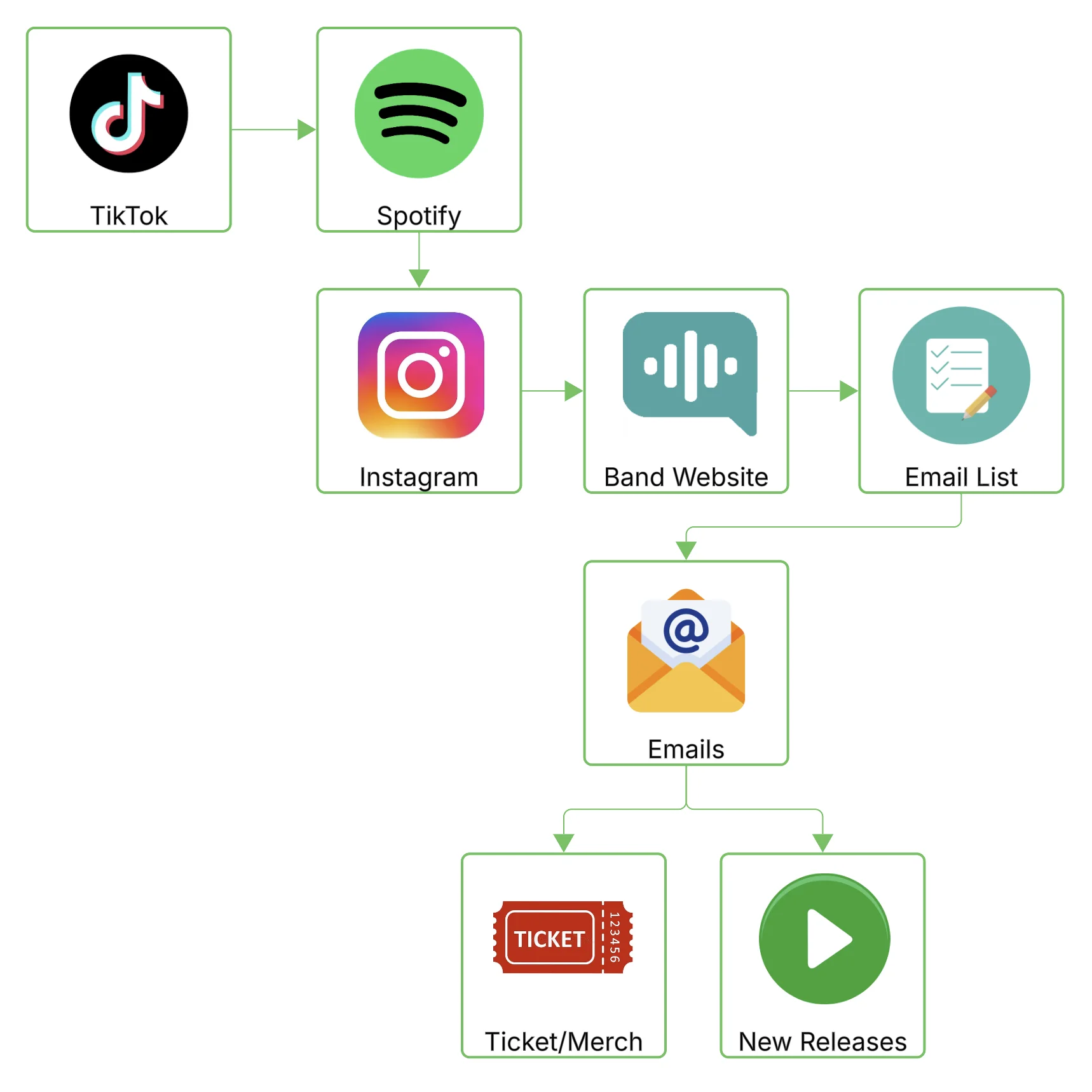
Modern music discovery rarely happens on a single platform anymore. A listener might first discover your music on TikTok, check you out on Spotify, follow you on Instagram, and eventually visit your band website.
Each platform plays a different role. Social media helps create discovery, streaming platforms help validate the music, and your website helps create a deeper connection around your brand and music.
That’s also why email lists still matter. Once someone joins your email list, you have a direct way to communicate about new releases, merch, shows, and future updates without relying entirely on social media algorithms.
The goal is not to force people off platforms. It’s to gradually guide casual listeners toward stronger long-term engagement over time.
What a Band Website Actually Does
A band website will not replace social media or streaming, done right, it will complement your social media and streaming efforts. It’s a controlled environment where the entire space is centered around your brand, your sound and your story. It gives people a chance to dive deeper.
When someone discovers you through a short clip or playlist, they usually interact once and move on. A website gives them a reason to stay longer, explore more than one track and start forming some form of connection. It also gives you the ability to guide that experience as you get to decide what the potential fan sees first.
What to Put on a Band Website (Without Overthinking It)
One of the reasons musicians hesitate to build a website is because it feels complicated. In reality, it doesn’t need to be. Actually a strong band website is simple.
| Section | Purpose | What It Should Include | Why It Matters |
|---|---|---|---|
| Homepage | First impression | Artist image, short tagline, featured track, clear direction | Visitors decide in seconds whether to stay—this needs to communicate your sound immediately |
| Music Section | Showcase your best work | 3–5 strongest tracks, clean layout, easy navigation | Too many songs creates friction—curation builds interest |
| Song Detail Pages | Deep engagement | Audio player (even 15 sec sample), short description, video, streaming links | These can double as landing pages for ads and promotion |
| About / Bio | Identity and context | Short, readable bio explaining your sound and direction | Helps listeners understand who you are without overwhelming them |
| Events / Shows | Real-world connection | Upcoming shows, locations, dates | Reinforces that you're active and gives fans a reason to engage offline |
| Email Signup | Audience ownership | Simple form, optional incentive | One of the only ways to maintain direct communication with fans |
| Social Links | Platform access | Clearly visible links to active platforms | Makes it easy for fans to follow you where they already spend time |
| Press / Contact | Opportunities | Contact form or email, basic press info | Reduces friction for bookings, features, and collaborations |
💡 More Info: Learn more about creating a point of contact for music opportunities (EPK)
Top Band Website Mistakes to Avoid
The “Junk Drawer” Website Problem: A band website isn’t a dumping ground for every idea, every track, every minor update which results in clutter and visitors will not know where to focus. If someone lands on your website and it’s not immediately obvious what they should do, they will leave. To solve this, a band website needs to have a direction. The main purpose should be to acquire visitor email addresses and subsequent purpose is to showcase your best music and entice visitors to follow your music.
A Band Website is NOT a “One and Done” Scenario: There’s a tendency to treat the band website as a one-time project, a stale website will ultimately fail to capture the visitor by not being relatable to people’s current needs. Your band website content should evolve as your music and direction evolves.
Overcomplicating the Visitor Experience to Showcase Artistry: Some artists have expensive web design experience or leverage AI to code a website but go wild in terms of user-experience which can be cool for the techy visitor but frustrating for the average visitor. The band website needs to serve as a conversation tool to maintain communication with the band’s audience. To achieve this, the band website should follow best practices for the best possible (and simple) user experience.
Poor Content Quality: Quickly designed album covers, poorly taken band photos, quickly written song descriptions and bio will take away from all the hard work in the band’s music. The basics of a “brand” is anything that the listener (or potential listener) can see, hear, or touch needs to be of quality, consistent and memorable. That means your music, your stage visuals, your logo, photos, album covers, your written content are all important brand-experience collateral that makes your band, your band.
Merch over Connection: If selling t-shirts becomes the main focus of the band website can make the website feel too transactional. Selling merch can be an important part of revenue generation, the problem is if that becomes the focus of the band website before establishing a connection. Most fans aren’t ready to purchase the first time they discover you. They need a reason to care first. Your band website should lead with your music and your identity / brand.
Where Your Band Website Fits in Your Overall Strategy
A band website doesn’t sit on its own. It works as part of everything else you’re doing. When you post on social media, you are creating entry-points. When releasing music, you’re generating interest. When you run advertising campaigns (or get media coverage), you’re bringing in traffic. And your band website where that traffic lands is what matters.
Instead of sending people to platforms where they might get distracted or leave, your band website will give them a focused experience first. From there, they can still go to streaming services or social media profiles. But on your terms and adds structure to what would otherwise be random.
One of the biggest benefits of having a band website may not be immediate but it’s what happens over time. Every person who visits has a place to return to. Every release has a central home. Every piece of content you create has somewhere consistent to point to and instead of starting from zero with every new post or release, you start building something that accumulates. That doesn’t happen overnight. But it doesn’t happen at all without a foundation.
Get Your Domain Name (Keep It Simple and Consistent)
One of the simplest but most important steps when setting up your band website is getting your own domain name through stable services like godaddy.com. A domain name is your website address (for example: yourbandname.com). It gives your project a clear, professional home that you control and can use across everything you do. Using a custom domain name helps:
- Make your brand look more professional and established
- Give fans an easy way to remember where to find you
- Create consistency across your website, social media, and promotional material
- Give you a stable link to use in ads, bios, and content
If you’re trying to keep things cost-effective, you don’t need to overcomplicate your setup. You can pair your domain name with a simple email like yourbandname@gmail.com to keep your branding consistent without needing to pay for a full custom email inbox right away. As your project grows, you can always upgrade to a custom email (like hello@yourbandname.com), but it’s not required to get started. The important thing is to lock in your name early and keep it consistent everywhere your music lives.
Do Musicians Need a Custom Website or Expensive Website Builders?
Short answer: No, not really!
For most artists, the priority should be getting a band website live that represents them properly. A simple and clean band website is more valuable than waiting for something “perfect” or overspending on extremely feature-rich and expensive website platforms. As things grow and evolve, you can refine your band website, improve the design and adjust the layout and add features that actually make sense for the brand and music.
The biggest mistake musicians make here is thinking the technology is what makes the website effective. It’s not. What actually matters is:
- how clearly your music is presented
- how easy it is to navigate
- and whether visitors know what to do when they land on your site
A basic website that loads fast, works well on mobile, and highlights your best music will outperform a complex, expensive site almost every time.
💡 More Info: Have a look at the band website builders guide.
Key Takeaways and Final Thoughts
- You do need a band website to build long-term growth
- Social platforms create attention, websites help retain it
- A simple website is more effective than a complex one
- Your website should support your music, not distract from it
A band website is not just another tool, it’s a foundational layer that supports everything else you do. Social media, streaming platforms and promotion can bring people in but your website is what gives them a place to connect, explore your music and stay engaged over time.
Ready to Build Your Band Website?
Get started in minutes with no credit card, no time limits, no hassle. Includes built-in AI tools to help you write bios, song descriptions and even artwork!